大模型从0到1|第八讲:手撕大模型并行训练
课程链接:Stanford CS336 Spring 2025 - Lecture 8: Distributed Training Implementation
课程概述
上周回顾: 单个 GPU 内的并行化
本周重点: 多 GPU 跨节点的并行化
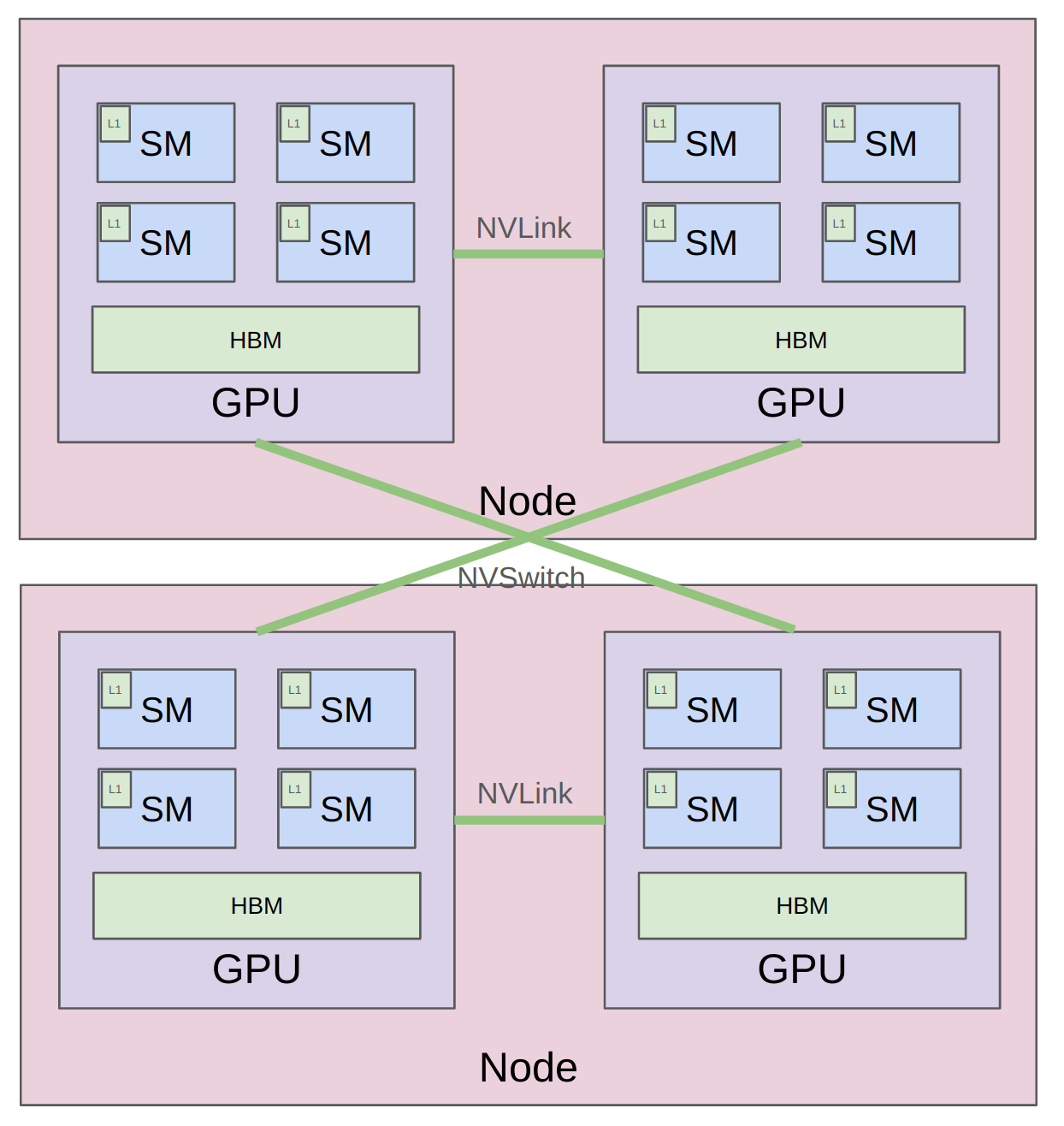
统一主题: 在两种情况下,计算单元(算术逻辑单元)都远离数据(输入/输出)
核心思想: 编排计算以避免数据传输瓶颈
- 上周: 通过融合/分块减少内存访问
- 本周: 通过复制/分片减少跨 GPU/节点的通信
广义的内存层次结构
从小/快到大/慢:
- 单节点,单 GPU: L1 Cache / Shared Memory
- 单节点,单 GPU: HBM (High Bandwidth Memory)
- 单节点,多 GPU: NVLink
- 多节点,多 GPU: NVSwitch
本讲目标: 用代码具体化上一讲的概念
Part 1: 分布式通信/计算的基础模块
1.1 集合操作 (Collective Operations)
定义: 分布式编程的概念原语
来源: 1980 年代并行编程文献中的经典概念
优势: 比自己管理点对点通信更好/更快的抽象
术语: - World Size(世界大小): 设备数量(例如 4) - Rank(秩): 单个设备(例如 0, 1, 2, 3)
1.1.1 Broadcast(广播)

操作: 将一个设备的数据复制到所有设备
用途: 分发模型参数、配置信息
1.1.2 Scatter(分散)

操作: 将数据分割并分发到各个设备
用途: 分发数据批次
1.1.3 Gather(收集)

操作: 从所有设备收集数据到一个设备
用途: 收集预测结果、日志信息
1.1.4 Reduce(归约)

操作: 对所有设备的数据执行关联/交换操作(sum, min, max)
用途: 计算全局统计量
1.1.5 All-Gather(全收集)

操作: 每个设备都收集所有设备的数据
用途: 同步分片数据
1.1.6 Reduce-Scatter(归约分散)
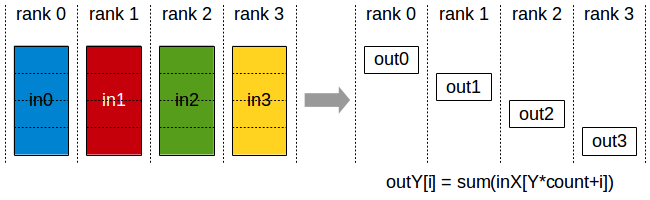
操作: 归约后将结果分散到各设备
用途: 梯度同步的第一步
1.1.7 All-Reduce(全归约)

关键关系: All-Reduce = Reduce-Scatter + All-Gather
用途: 梯度同步(最常用)
记忆技巧
- Reduce: 执行关联/交换操作(sum, min, max)
- Broadcast/Scatter: 是 Gather 的逆操作
- All: 目标是所有设备
1.2 硬件架构
经典架构(家用)

- 同节点 GPU: 通过 PCIe 总线通信(v7.0, 16 lanes => 242 GB/s)
- 跨节点 GPU: 通过以太网通信(~200 MB/s)
现代架构(数据中心)
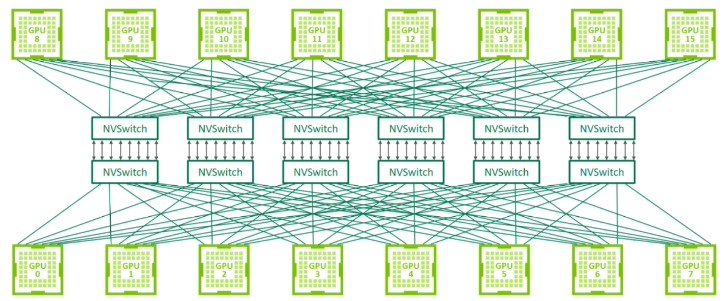
- 节点内: NVLink 直连 GPU,绕过 CPU
- 跨节点: NVSwitch 直连 GPU,绕过以太网
H100 规格: - 18 个 NVLink 4.0 链路 - 总带宽:900 GB/s - 对比 HBM 带宽:3.9 TB/s
查看硬件拓扑:
1.3 NVIDIA Collective Communication Library (NCCL)
功能: 将集合操作转换为 GPU 间传输的底层数据包
工作流程: 1. 检测硬件拓扑(节点数、交换机、NVLink/PCIe) 2. 优化 GPU 间路径 3. 启动 CUDA kernel 发送/接收数据
参考: NCCL Talk
1.4 PyTorch Distributed (torch.distributed)
功能:
- 提供集合操作的简洁接口(如 all_gather_into_tensor)
- 支持多种后端:gloo (CPU), nccl (GPU)
- 支持高级算法(如 FullyShardedDataParallel)
示例代码:All-Reduce
def collective_operations_main(rank: int, world_size: int):
    setup(rank, world_size)

    # 创建张量
    tensor = torch.tensor([0., 1, 2, 3], device=get_device(rank)) + rank

    print(f"Rank {rank} [before all-reduce]: {tensor}")

    # 执行 all-reduce(原地修改)
    dist.all_reduce(tensor=tensor, op=dist.ReduceOp.SUM, async_op=False)

    print(f"Rank {rank} [after all-reduce]: {tensor}")

    cleanup()
输出示例(world_size=4):
Rank 0 [before]: [0., 1., 2., 3.]
Rank 1 [before]: [1., 2., 3., 4.]
Rank 2 [before]: [2., 3., 4., 5.]
Rank 3 [before]: [3., 4., 5., 6.]

Rank 0 [after]: [6., 10., 14., 18.]  # 每个位置求和
Rank 1 [after]: [6., 10., 14., 18.]
Rank 2 [after]: [6., 10., 14., 18.]
Rank 3 [after]: [6., 10., 14., 18.]
示例代码:Reduce-Scatter + All-Gather
# Reduce-Scatter
input = torch.arange(world_size, dtype=torch.float32, device=get_device(rank)) + rank
output = torch.empty(1, device=get_device(rank))

print(f"Rank {rank} [before reduce-scatter]: input = {input}, output = {output}")
dist.reduce_scatter_tensor(output=output, input=input, op=dist.ReduceOp.SUM, async_op=False)
print(f"Rank {rank} [after reduce-scatter]: input = {input}, output = {output}")

# All-Gather
input = output
output = torch.empty(world_size, device=get_device(rank))

print(f"Rank {rank} [before all-gather]: input = {input}, output = {output}")
dist.all_gather_into_tensor(output_tensor=output, input_tensor=input, async_op=False)
print(f"Rank {rank} [after all-gather]: input = {input}, output = {output}")
验证: All-Reduce = Reduce-Scatter + All-Gather ✅
1.5 性能测试
All-Reduce 性能测试
def all_reduce(rank: int, world_size: int, num_elements: int):
    setup(rank, world_size)

    # 创建张量
    tensor = torch.randn(num_elements, device=get_device(rank))

    # Warmup
    dist.all_reduce(tensor=tensor, op=dist.ReduceOp.SUM, async_op=False)
    torch.cuda.synchronize()
    dist.barrier()

    # 计时
    start_time = time.time()
    dist.all_reduce(tensor=tensor, op=dist.ReduceOp.SUM, async_op=False)
    torch.cuda.synchronize()
    dist.barrier()
    end_time = time.time()

    duration = end_time - start_time

    # 计算有效带宽
    size_bytes = tensor.element_size() * tensor.numel()
    sent_bytes = size_bytes * 2 * (world_size - 1)  # 2x:发送输入 + 接收输出
    total_duration = world_size * duration
    bandwidth = sent_bytes / total_duration

    print(f"Rank {rank}: bandwidth = {round(bandwidth / 1024**3)} GB/s")

    cleanup()
测试:
Part 2: 分布式训练策略
示例模型: 深度 MLP(多层感知机)
原因: MLP 是 Transformer 的计算瓶颈,具有代表性
三种并行策略: 1. Data Parallelism(数据并行): 沿批次维度切分 2. Tensor Parallelism(张量并行): 沿宽度维度切分 3. Pipeline Parallelism(流水线并行): 沿深度维度切分
2.1 Data Parallelism(数据并行)
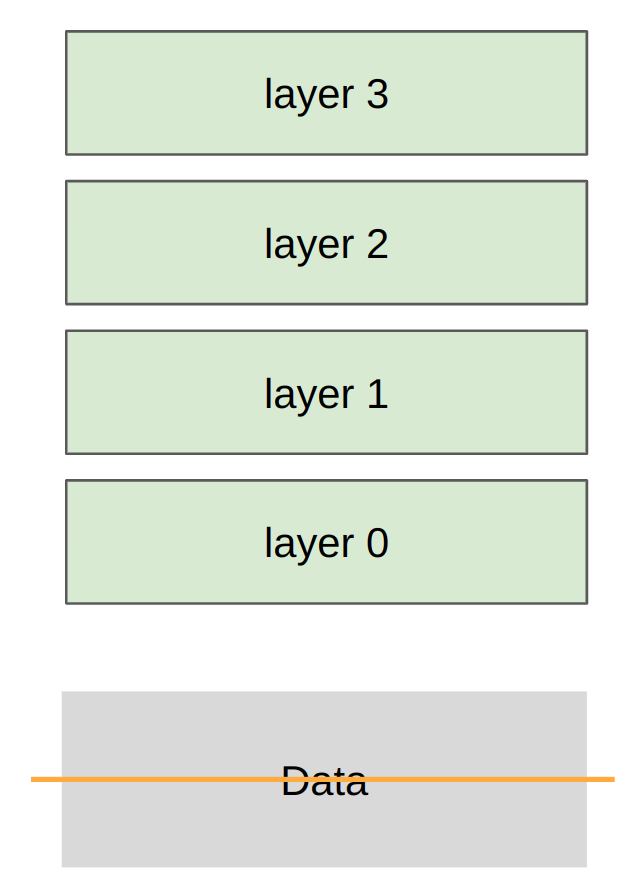
分片策略: 每个 rank 获得数据的一个切片
实现代码
def data_parallelism_main(rank: int, world_size: int, data: torch.Tensor, num_layers: int, num_steps: int):
    setup(rank, world_size)

    # 获取此 rank 的数据切片
    batch_size = data.size(0)
    local_batch_size = batch_size // world_size
    start_index = rank * local_batch_size
    end_index = start_index + local_batch_size
    data = data[start_index:end_index].to(get_device(rank))

    # 创建模型参数(每个 rank 拥有所有参数)
    params = [get_init_params(num_dim, num_dim, rank) for i in range(num_layers)]
    optimizer = torch.optim.AdamW(params, lr=1e-3)

    for step in range(num_steps):
        # 前向传播
        x = data
        for param in params:
            x = x @ param
            x = F.gelu(x)
        loss = x.square().mean()

        # 反向传播
        loss.backward()

        # 同步梯度(与标准训练的唯一区别)
        for param in params:
            dist.all_reduce(tensor=param.grad, op=dist.ReduceOp.AVG, async_op=False)

        # 更新参数
        optimizer.step()

        print(f"Rank {rank}: step = {step}, loss = {loss.item()}")

    cleanup()
关键观察
不同之处: - ✅ 每个 rank 的 Loss 不同(基于本地数据计算) - ✅ 梯度通过 all-reduce 同步,所有 rank 相同 - ✅ 因此,参数在所有 rank 上保持一致
通信成本: - 每步需要 all-reduce 所有梯度 - 通信量 = 模型参数量
优点: - 实现简单 - 扩展性好(理想情况下线性加速)
缺点: - 每个 GPU 需要存储完整模型 - 通信开销随模型大小增长
2.2 Tensor Parallelism(张量并行)
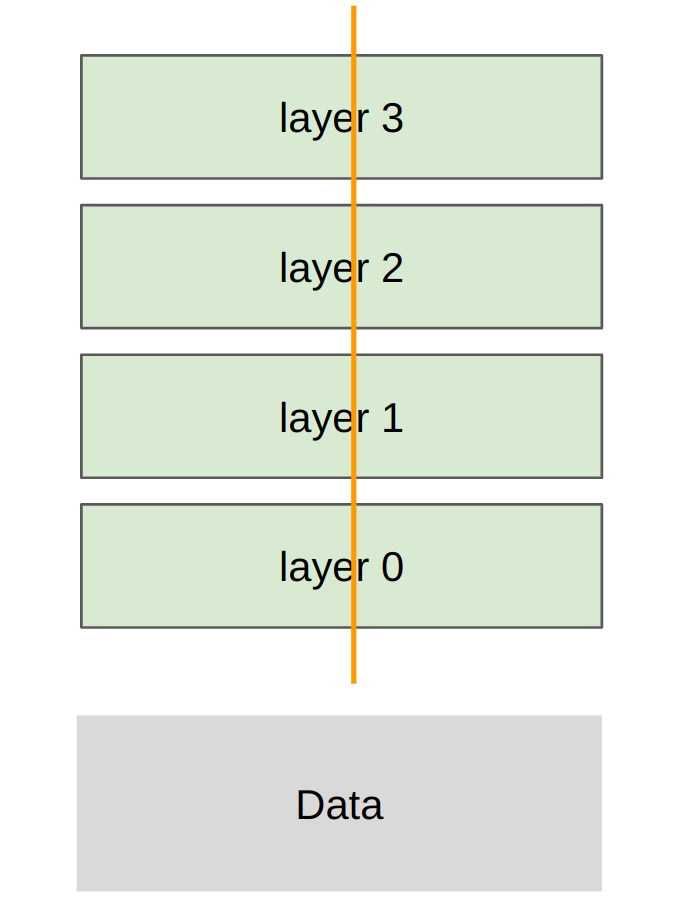
分片策略: 每个 rank 获得每层的一部分,传输所有数据/激活
实现代码
def tensor_parallelism_main(rank: int, world_size: int, data: torch.Tensor, num_layers: int):
    setup(rank, world_size)

    data = data.to(get_device(rank))
    batch_size = data.size(0)
    num_dim = data.size(1)
    local_num_dim = num_dim // world_size  # 分片 num_dim

    # 创建模型(每个 rank 获得 1/world_size 的参数)
    params = [get_init_params(num_dim, local_num_dim, rank) for i in range(num_layers)]

    # 前向传播
    x = data
    for i in range(num_layers):
        # 计算激活(batch_size x local_num_dim)
        x = x @ params[i]  # 注意:这只是参数的一个切片
        x = F.gelu(x)

        # 为激活分配内存(world_size x batch_size x local_num_dim)
        activations = [torch.empty(batch_size, local_num_dim, device=get_device(rank))
                      for _ in range(world_size)]

        # 通过 all-gather 发送激活
        dist.all_gather(tensor_list=activations, tensor=x, async_op=False)

        # 拼接得到 batch_size x num_dim
        x = torch.cat(activations, dim=1)

    print(f"Rank {rank}: forward pass produced activations {summarize_tensor(x)}")

    # 反向传播:作业练习

    cleanup()
关键观察
内存分布: - ✅ 每个 rank 只存储部分参数 - ✅ 激活需要在所有 rank 间通信
通信成本: - 每层需要 all-gather 激活 - 通信量 = 激活大小 × 层数
优点: - 可以训练更大的模型(参数分片) - 适合宽模型
缺点: - 通信频繁(每层都需要通信) - 实现复杂度高
2.3 Pipeline Parallelism(流水线并行)
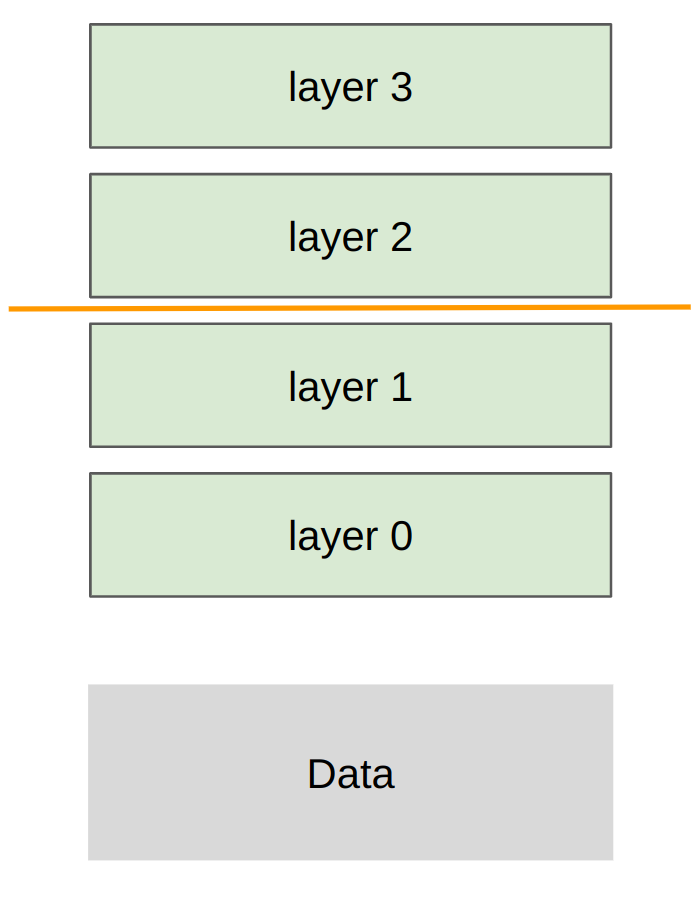
分片策略: 每个 rank 获得层的子集,传输所有数据/激活
实现代码
def pipeline_parallelism_main(rank: int, world_size: int, data: torch.Tensor,
                             num_layers: int, num_micro_batches: int):
    setup(rank, world_size)

    data = data.to(get_device(rank))
    batch_size = data.size(0)
    num_dim = data.size(1)

    # 分割层
    local_num_layers = num_layers // world_size

    # 每个 rank 获得层的子集
    local_params = [get_init_params(num_dim, num_dim, rank) for i in range(local_num_layers)]

    # 前向传播

    # 分成 micro-batch 以最小化气泡
    micro_batch_size = batch_size // num_micro_batches
    if rank == 0:
        micro_batches = data.chunk(chunks=num_micro_batches, dim=0)
    else:
        micro_batches = [torch.empty(micro_batch_size, num_dim, device=get_device(rank))
                        for _ in range(num_micro_batches)]

    for x in micro_batches:
        # 从前一个 rank 接收激活
        if rank - 1 >= 0:
            dist.recv(tensor=x, src=rank - 1)

        # 计算分配给此 rank 的层
        for param in local_params:
            x = x @ param
            x = F.gelu(x)

        # 发送到下一个 rank
        if rank + 1 < world_size:
            print(f"Rank {rank}: sending {summarize_tensor(x)} to rank {rank + 1}")
            dist.send(tensor=x, dst=rank + 1)

    # 未处理:重叠通信/计算以消除流水线气泡

    # 反向传播:作业练习

    cleanup()
关键观察
Micro-Batch 技术: - 将批次分成更小的 micro-batch - 减少流水线气泡(idle time) - 提高 GPU 利用率
通信模式: - 点对点通信(send/recv) - 只在相邻 rank 间通信
优点: - 内存效率高(每个 GPU 只存储部分层) - 适合深模型
缺点: - 流水线气泡导致 GPU 空闲 - 需要精心设计 micro-batch 调度
并行策略对比
| 策略 | 分片维度 | 通信模式 | 内存效率 | 适用场景 |
|---|---|---|---|---|
| Data Parallelism | Batch | All-Reduce | 低(完整模型) | 小模型,大批次 |
| Tensor Parallelism | Width | All-Gather | 中(参数分片) | 宽模型 |
| Pipeline Parallelism | Depth | Send/Recv | 高(层分片) | 深模型 |
混合并行策略
实际应用: 通常组合多种策略
示例:GPT-3 训练 - Data Parallelism: 跨节点 - Tensor Parallelism: 节点内(利用 NVLink) - Pipeline Parallelism: 跨层
其他并行维度: - Sequence Parallelism: 沿序列长度切分 - Expert Parallelism: MoE 模型中的专家并行
高级话题
通信与计算重叠
目标: 在计算时进行通信,隐藏通信延迟
技术:
- 异步通信(async_op=True)
- 梯度累积
- 流水线调度
内存优化
权衡: - 重计算(Recomputation): 节省内存,增加计算 - 存储(Memory): 增加内存,减少计算 - 通信(Communication): 存储在其他 GPU,需要通信
ZeRO 优化: - ZeRO-1: 优化器状态分片 - ZeRO-2: 梯度分片 - ZeRO-3: 参数分片
课程未涵盖的内容
更复杂的模型: - Attention 机制 - 更复杂的架构
更多优化: - 通信/计算重叠 - 更复杂的调度
其他框架: - JAX/TPU: 只需定义模型和分片策略,编译器处理其余部分 - 参考:Levanter - PyTorch: 本课程使用,可以看到如何从原语构建
总结
核心概念
- 多种并行化方式:
- Data(batch)
- Tensor/Expert(width)
- Pipeline(depth)
-
Sequence(length)
-
三种权衡:
- 重计算(Recompute)
- 存储在内存(Memory)
-
存储在其他 GPU 并通信(Communicate)
-
硬件趋势:
- 硬件越来越快
- 但总是想要更大的模型
- 因此总会有这种层次结构
关键原则
统一主题: 编排计算以避免数据传输瓶颈
上周: 单 GPU 内 - 减少内存访问(融合/分块)
本周: 多 GPU 间 - 减少通信(复制/分片)
实践建议
Setup 函数
def setup(rank: int, world_size: int):
    # 指定 master 位置(rank 0),用于协调
    os.environ["MASTER_ADDR"] = "localhost"
    os.environ["MASTER_PORT"] = "15623"

    if torch.cuda.is_available():
        dist.init_process_group("nccl", rank=rank, world_size=world_size)
    else:
        dist.init_process_group("gloo", rank=rank, world_size=world_size)

def cleanup():
    torch.distributed.destroy_process_group()
多进程启动
延伸阅读
NCCL 性能: - How to reason about operations - Sample benchmark code
分布式训练: - PyTorch Distributed Tutorial - FSDP Documentation - DeepSpeed - Megatron-LM
硬件: - NVLink Documentation - H100 Datasheet
作业练习
- 实现 Tensor Parallelism 的反向传播
- 实现 Pipeline Parallelism 的反向传播
- 测量不同并行策略的通信开销
- 实现混合并行策略(Data + Tensor)
- 优化流水线调度以减少气泡